
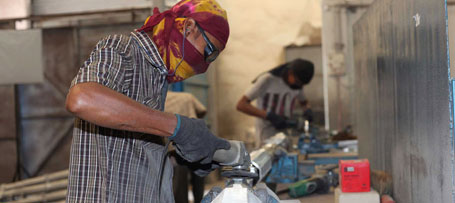
Unprecedented surge in the year 2025 for the electric automotive industry is triggered, to a great extent, by technological progress, stringent environmental laws, and increased consumer demand for clean transport. Aluminum casting positions itself as the central core for this manufacturing-upturn trend. Since lighter, stronger, and more efficient EV parts occupy the central focus of an automaker’s grinding operation, that is exactly what aluminum casting solutions must deliver. Given that aluminum casting solutions are versatile and have an excellent strength-to-weight ratio while being cost-friendly. It is this very nature of aluminum casting that is facilitating a transformation in the automotive field.
The Role of Aluminum Casting in EV Manufacturing
Aluminum casting has been instrumental in revolutionizing the way electric vehicles are built and optimized. Aluminum parts reduce vehicle weight enormously compared to steel parts on a classic car. Thus affecting the vehicle’s range, acceleration, and general efficiency. Through aluminum castings, manufacturers can invent highly complex, very precise parts that are light and sturdy at the same time.
However, in recent years manufacturers have increased aluminum casting processes like investment casting, die casting, and sand casting to manufacture critical components. These processes are used for manufacturing battery enclosures, motor housings, chassis components, and structural reinforcements. Manufacturing with critical geometries with utmost accuracy allows for top-notch operational safety and is very aesthetic to view, while its time for manufacture is reduced, and therefore the cost has also taken a dart downwards.
Advantages of Aluminum Casting Solutions in EV Production
Lightweight Components: The aluminum part being light helps reduce the weight of the vehicle, which is paramount in increasing range and handling in EVs.
Great Design Flexibility: Casting in aluminum allows the inclusion of complicated shapes and design features into one piece. Thus, fewer parts are necessary, and the assembly operations are very simple.
Thermal Goodness: Aluminum, owing to its being a great thermal conductor, will help its heat-management system in dissipating heat generated from batteries and electric motors inside the aluminum-cast structure. It ensures safety and performance.
Cost and Scalability: Aluminum casting processes are highly scalable. Thus fit to manufacture products in mass quantity while standing at the helm of quality. Such scalability helps manufacturers to build cost-effective lines of EVs to cope with the looming demand.
How Aluminum Casting Solutions Are Accelerating EV Innovation
In 2025, the adoption of aluminum casting solutions is directly influencing the development of next-generation EVs. Manufacturers are utilizing these solutions to design lighter yet stronger frame structures, which improve crash safety and ride comfort. Additionally, aluminum castings are used to produce complex battery enclosures that provide better protection, thermal management, and ease of assembly.
Additionally, aluminum casting is crucial in producing high-performance electric motors. Motor housings are coated or built using precise casting techniques. Stator parts enable optimum electromagnetic performance and mechanical strength, extending motor life. The capability to produce complex components quickly and accurately offers a significant advantage to automakers. This advantage allows automakers to innovate faster and bring new EVs to market more efficiently.
The Future of Aluminum Casting in the EV Industry
Being in an environment where the pure exponential growth of the EV market continues, aluminum casting solutions will find a further niche in automotive design and manufacturing. New casting technologies, such as additive manufacturing and precision casting, must be utilized to create more intricate and high-performance EV components. They also marry well with the eco-friendly agenda of electric vehicles, being theoretically sustainable when aluminum casting is carried out in association with recycling and energy conservation.
On the other hand, automotive brands are also investigating how aluminum casting can assist in vehicle modularity, enabling upgrades and customization. This brings flexibility to accelerate innovation while cutting costs and environmental impact. Thus contributing to the global agenda for sustainable mobility solutions.