
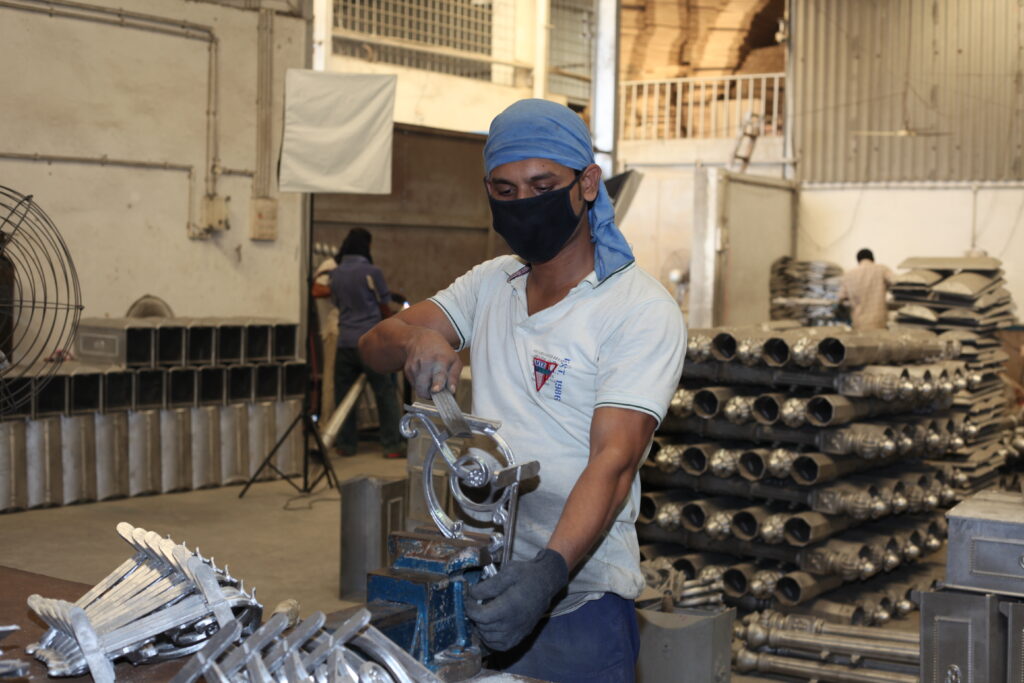
The aerospace industry needs parts that have precision, strength, and that are light in weight. The given standards can only meet the advanced manufacturing methods that can manufacture complicated shapes with great accuracy and superb quality. In the aerospace industry, aluminum investment casting quickly found the crown as the technique of choice for making parts. This process exhibits so many benefits relevant to the binding application needs, thereby placing high demand for aluminum investment casting foundry services in this sector.
Benefits of Aluminum Investment Casting for Making Aerospace Components
1. An Industry Phenomenon of Precision and Complexity of Geometry
Aluminum investment casting into aerospace components is employed to manufacture highly complex and precise parts. The process usually involves the production of a wax or polymer pattern, a poster child in the idea of intricate detail, which is then coated with ceramic to form a mold. After the wax is melted and poured away, molten aluminum is filled in the mold to assume complicated shapes with extremely tight tolerances. The procedure is the greatest fit for parts with internal channels that are very complicated in geometry and have remarkably fine surface finishes that other casting methods rarely achieve. An aluminum investment casting foundry can provide parts that strictly abide by aerospace standards for best functionality and safety.
2. Lightweight and High-Strength Aluminum Alloys
Aluminum is renowned for its excellent strength-to-weight ratio, which is crucial in aerospace applications where reducing weight can significantly improve fuel efficiency and payload capacity. Aluminum investment casting allows for the use of high-strength aluminum alloys, such as 2024, 6061, and 7075, specifically made for aerospace requirements. Such alloys are made to endure extreme conditions with temperature and mechanical stresses, making them especially suitable for severe conditions such as the manufacture of engine parts, structural elements, and landing gear components.
3. Exquisite Surface Finish and Dimensional Accuracy
For aerospace components, a good-quality surface finish is necessary so that proper aerodynamics can be attained and drag reduction can be facilitated, not to forget the ease of assembly. Aluminum investment casting offers good surface finishes, which often preclude the requirement of further machining or finishing. This shortens the lead time and cuts down on the production cost. Of course, the other great feature of the process is that it affords the best dimensional accuracy so that the parts are within the safety and performance standards required by aerospace from precisely designed specifications.
4. Cost-Effective for Small to Medium Production Runs
Whereas some manufacturing procedures favor mass production, aluminum investment casting favors any small- to medium-sized batch production. Initial tooling costs remain quite low, and quick modifications to designs are possible, which are essential in aerospace, where iterative testing and prototyping are the order of the day. Aluminum investment casting foundry provides a timely yield of complex aerospace components without having to incur the high costs of other manufacturing procedures in comparison.
5. Reduced Material Waste and Sustainability
Aluminum investment casting is a near-net-shape process, meaning parts are produced close to their final dimensions, minimizing material waste. In addition, aluminum is highly recyclable, and any scrap materials can be melted down and reused repeatedly without any pressure on its properties. This aspect of sustainability hence makes aluminum investment casting an environmentally friendly option for aerospace manufacturers who are set on following green manufacturing practices.